Smart Batching and Idle Strategy
Stop batching messages in your application. Aeron already does it for you — better, and without adding latency.
The core principle is one line: send immediately, don’t wait. Publish each message the moment it arrives. The C media driver coalesces what’s already in the buffer into fewer syscalls via sendmmsg(). You get the throughput benefit of batching without paying the latency tax of waiting to fill a batch.
The knob that actually matters for the latency-vs-CPU tradeoff is the idle strategy — not your batch size.
Smart batching vs application-level batching
Section titled “Smart batching vs application-level batching”Aeron’s smart batching is fundamentally different from application-level batching:
- Don’t try to aggregate multiple messages to fit into a single MTU — there are diminishing returns.
- The C media driver handles batching automatically at the transport level via
sendmmsg(). - Application code should just publish messages as they arrive.
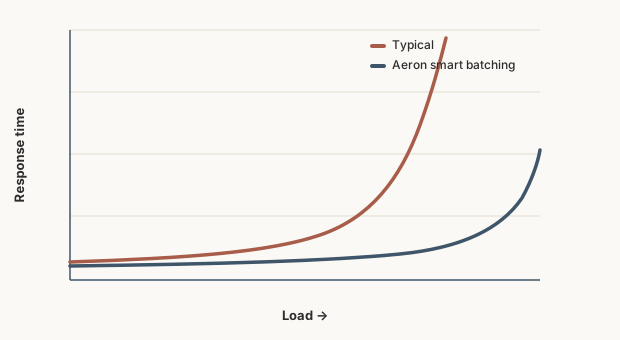
The transport naturally coalesces messages that arrive close together into fewer syscalls. No application logic required, and crucially, no added wait time.
Diminishing returns on batch size
Section titled “Diminishing returns on batch size”Larger batches stop helping fast. The performance gain curve is classic diminishing returns.
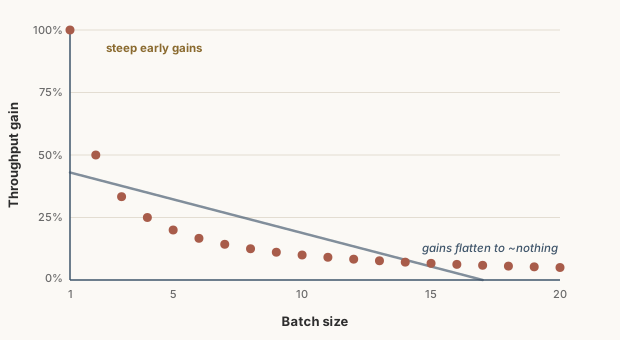
- Going from batch=1 to batch=2 gives a big improvement.
- Going from batch=8 to batch=16 gives almost nothing.
This is why hand-rolled batching loses. The throughput upside flattens quickly, but every message you hold back to grow the batch adds directly to p50 and p99. You pay a guaranteed latency cost for a marginal — eventually negligible — throughput gain.
The idle strategy is your real knob
Section titled “The idle strategy is your real knob”The idle strategy controls how often a thread polls versus yields the CPU. That choice is your true latency-vs-CPU lever.
| Strategy | Behavior | Use Case |
|---|---|---|
| BusySpin / NoOp | Never yields CPU, polls continuously | Lowest latency, highest CPU cost |
| Sleeping / Yield | Yields CPU between polls | Lower CPU usage, higher latency |
How to read this against your latency budget:
- BusySpin / NoOp drives p50 and p99 to their floor by never sleeping through an arriving message — at the cost of a fully pinned core. Reserve it for dedicated, isolated cores where the CPU is yours to burn.
- Sleeping / Yield trades latency for headroom. The thread gives the CPU back between polls, so a message can land mid-sleep and wait — inflating both p50 and especially p99. Use it when CPU is shared or contended and your tail budget can absorb the jitter.
For the internals of how the media driver coalesces sends and how each idle strategy is implemented, see The Aeron Files.
This site is not affiliated with, endorsed by, or sponsored by Adaptive Financial Consulting Limited or the Aeron project. Aeron is a registered trademark of Adaptive Financial Consulting Limited.
Aeron is a trademark of Adaptive Financial Consulting Limited in the United Kingdom and other countries.